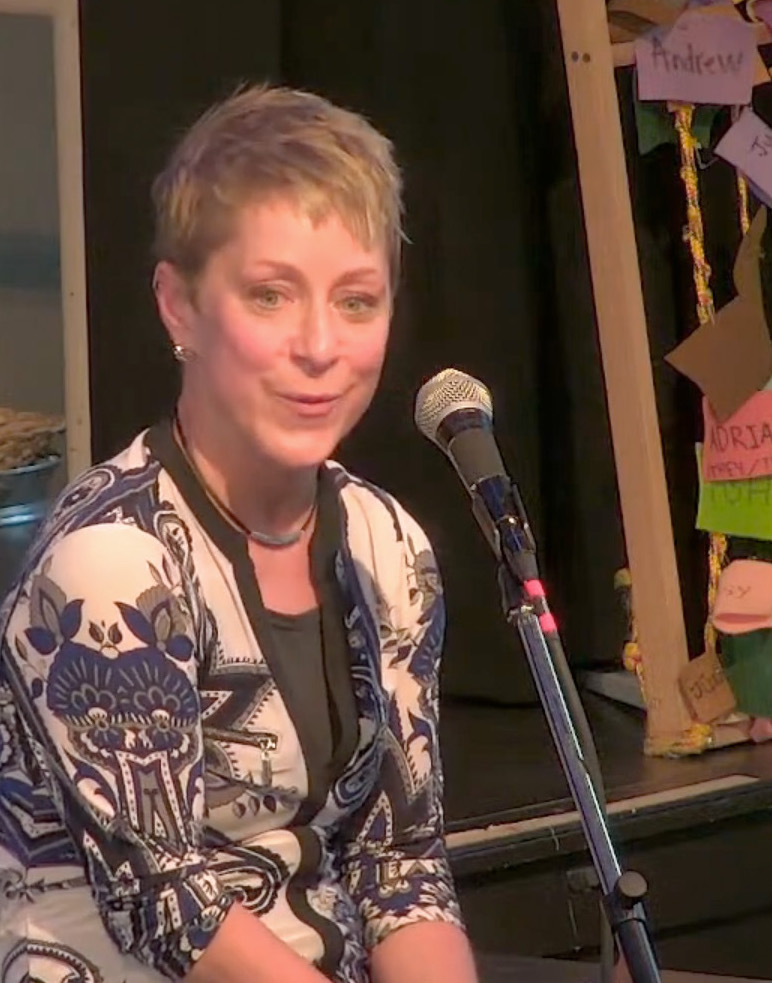
This post is a lightly edited transcript of my reflection shared on July 23, 2023, at Valley & Mountain Fellowship, an alternative, progressive church in Seattle. This is my own spiritual community, in which I co-lead the immigration justice team.
I want to talk with you today about one of the concepts that’s been foundational in my journey. It’s the concept of Just Peace. I have been wrestling with this concept for about 25 years and will probably continue to wrestle with it until the day that I die. It’s worth talking about because we probably all wrestle with it in some way. That wrestling looks very different for every person. I’m going to tell you what it looks like for me, using a lot of “I” statements, because your experience in the body and life you inhabit is probably different.
Just Peace is a phrase that comes out of the Christian tradition. It actually exists in multiple Christian streams, so the emphasis may differ depending on where you sit, but Just Peace always brings a challenge to our thinking. To Christians who sit within the “just war” tradition, Just Peace says: War is almost never just, so perhaps it’s best to start thinking about peace. To Christians who come from the peace tradition, like me, Just Peace is a way of saying: Yes, peace is where it’s at – but remember that without justice, there is no peace. And to Christians who come from the justice tradition, possibly including many in this room, Just Peace is a way of saying: Yes, justice is where it’s at – but remember that without peace, justice may not look the way you hope it will look in the long run.
One of the grounding scriptures underlying Just Peace is Psalm 85:10, which says:
“Kindness and truth shall meet; justice and peace shall kiss. Truth shall spring out of the earth, and justice shall look down from heaven.”
So mercy and truth have met each other, and justice and peace have kissed, in the context of this psalm about community healing and restoration after the trauma of forced displacement caused by war. This picture of justice and peace kissing is presented as a picture of what that restoration and healing process looks like. the way that the text is framed seems to tell us that this is a good thing, that justice and peace are meant to work together. Yet it’s not necessarily common – otherwise, why bother mentioning it in this psalm? Justice and peace kissing is not always the norm. There’s a creative tension built into this scripture that resonates with my experience and might resonate with yours as well.
Beyond that, this text becomes difficult to interpret. There are many debates about the different Hebrew words’ meaning in their original context. For example, the word translated as “peace” in this verse is not “shalom.” This is not the well-known Hebrew word shalom, which carries an all-encompassing sense of collective well-being, and which we understand as including justice and peace and truth and mercy and everything good. Instead, the word translated as “peace” in this verse is a more everyday, down-to-earth word that means something like avoiding conflict and confrontation. With that in mind, you can begin to appreciate the creative tension between justice and a kind of peace that avoids confrontation – because justice sometimes requires creative, constructive confrontation.
It’s equally helpful to know that the Hebrew word translated as “kiss” in this verse can also be translated as fight. Hmmmmm. That evokes quite a different meaning, right? Is this verse saying that justice and peace will kiss, or is it saying that justice and peace will fight? My response to that question is: Yes. Both things are true in my experience, and I don’t need either/or interpretation. I could probably spend the rest of my life trying to figure out what the original author meant here and never solve the mystery. In my experience, both of these things are true. Justice and peace do kiss … and they do fight.
I’d like to unpack a bit more of what the Just Peace journey has looked like for me in real life. It goes back about 25 years, when, as a young person, I was immersed in an intensive two-year church internship program. One of my primary assignments was to discern the spiritual and vocational “calling” for my life. That’s a somewhat problematic assignment, and it needs to be handled with care. But it did work for me at the time. The vocational call came through clearly as an invitation to contribute to “just and peaceful relationships between people groups.”
“Just and peaceful.” That’s precisely what I wrote down in my discernment journal. That is interesting because, despite the clear and equal presence of both justice and peace within that call, the balance between justice and peace has not always been manifested in my experience. I started out as a person who leaned pretty far toward the peace side, to the extent that I sometimes missed the justice component. Years later, some would say that I’ve now become a person who leans pretty far toward the justice side, and I risk missing the peace component. I’m not sure I ever passed through any transitional period of balance in the middle. So … how did that happen? How do you receive a balanced vocational call and yet experience struggle and imbalance in real life?
I believe this happens because we are all limited and shaped by our life experiences. We grow in the directions where we’re given opportunities and encouragement to grow. The first spaces in which I grew were the context of white evangelicalism and the context of the international humanitarian assistance sector. Considering who’s in this room today, I don’t think I need to explain to you the limitations of white American evangelicalism in the mid-1990s. I know you all understand it! You may be less familiar with the international humanitarian assistance sector, so it’s helpful to mention that while there was some excellent justice work happening in that space in the mid-1990s, the overall industry had not yet begun to reckon with its own ties to neo-colonialism and all the injustice that implies. There is now some genuine progress toward change in the humanitarian sector. However, in the mid-1990s, the overall leaning was toward the peace side, with the implicit message being that peace is important, but you should not raise a fuss.
So those were the directions where I initially had the opportunity to grow. I developed deep roots in Christian theologies of reconciliation. I saw a lot of fruit and goodness coming out of using those theologies, yet there were also a lot of limitations. I remember how shaken I was – in a good way – the first time an Indigenous colleague challenged my thinking. She said something like: “You know, I don’t really buy into that reconciliation concept. The idea of reconciliation implies that originally, there was a relationship that was good enough that it’s now worth repairing and returning to. But if a relationship has been crappy ever since the beginning, then it requires a very different kind of conversation.” And she was right. I still draw on those theologies of reconciliation – but I wear them very differently now, and I also draw on many other sources.
My opportunities to grow in a different direction came when my life context changed, when I began to work outside the USA on peace for about a decade in the Balkans, in Mexico, in the southern Philippines, and all over South and Southeast Asia, and shorter term in about 35 other countries. I was nearly always in highly conflicted situations. If you’re looking to transform yourself, there’s no better way than cross-cultural immersion, especially in a war zone that is marked by deep injustice. So, as you can imagine, I did change. I came out of those experiences different. I found myself particularly stretched whenever I encountered situations of deep injustice in which my own identity was affiliated with the perpetrators. As you can imagine, being a white US American, such situations arose quite often.
For example, I got very up close and personal with the effects of the US “Global War on Terror” in many places around the world. I saw that the War on Terror was about as effective as the US War on Drugs, which is to say that it really didn’t work at all. It was not effective, and it hurt and killed a great many non-combatants in the process. Most of those were people with brown skin or a faith other than Christianity. So that provoked a lot of anger in me. In fact, it caused an existential anger that I still carry with me every day. It also provoked a lot of introspection about how can I, as a person whose identity is affiliated with this monstrous practice … how can I be part of the change? How can I be part of the solution?
When I returned to the USA about ten years later, I was far better equipped to prioritize justice. However, I no longer knew how to communicate within the US cultural context. The context had changed, and I had changed, and it wasn’t easy to express myself. Many of my initial efforts to be an ally within this context did not fully “land.” I was trying to figure out how to code-switch all the time between how I communicated in other contexts and how I needed to communicate here. I was trying to navigate the context of increasing polarization, in which there is a real fear that if you open your mouth, you will be misunderstood and criticized, quite possibly by one of your allies. I was processing the grief of realizing that by building credibility with one segment of the US population, I risked losing credibility with other segments, and there was very little I could do about it. It clearly took me a while to re-learn how to communicate in the USA.
I think I’ve finally hit some kind of stride in the past several years. It’s not a perfect stride, and your feedback is welcome anytime! But at least I’m moving. And I’m not necessarily balanced. Really. Certainly, commitments to justice and peace are both still present. But many people observing me now would say: Yeah, you’re leaning pretty far out toward the justice side – so don’t forget about the peace.
Reflecting on this present moment, I will share a couple of the things that I’m currently re-learning. I say re-learning because all of these things represent functions that I’m professionally trained for and practiced for many years – but sometimes, in the day-to-day pain of the US context, there is a tendency to forget and a daily need for re-learning and re-commitment. This is also a work in progress, so if you talk to me again in a year, it will sound different. But I am re-learning that …
- Perhaps my idea of consistently balancing justice and peace in equal proportions was never a realistic goal. Perhaps the more realistic goal is to ensure that both justice and peace are always present in my work. If it’s my role to practice justice in a particular situation, then I should do that to the best of my abilities, while ensuring that my justice work is profoundly shaped and informed and infused by peace. And vice-versa.
- My efforts should take their cues from the context of what’s happening around me, rather than from my notions of what I feel like doing, or what I’m good at. This means pausing before I intervene to assess the context together with others and then determine what kind of action is needed. I’m reminded that if I need medical care, I don’t want a doctor who offers to operate on my spleen just because that’s what they are good at. I want a doctor who will listen to me, join me in assessing what’s wrong and then act accordingly. I also want a doctor who can recognize when they’re not the best person for the task and then stand down to bring in another doctor who is a better fit. In the same way, I remind myself to take my cues from the context and act accordingly.
- I have a responsibility to avoid contributing to unnecessary polarization. It’s true that some types of confrontation are necessary and engaging them can be a constructive act. Yet there’s no need to be mean while I’m doing it. There is space for kindness. When I see a person who is headed in a good direction, yet in an imperfect manner, how can I encourage that person? How can I first see what’s good and call it out to encourage them? And if there’s any input or correction to be offered, how can I do that privately to minimize the hurt and embarrassment? Or, when I encounter someone who is really manifesting hate, how do I respond to that? The temptation is to either strike back or walk away. Too often, I have to really take a beat to remember the simple insistence of Jesus that I should be loving my enemy. And that loving my enemy is not the same as selling out.
- When I am in the process of calling out a system that is doing evil … which is often the case in our immigration justice work as we confront the current detention and deportation practices of ICE … I have a responsibility to respect the individual human beings within that system, especially the ones who don’t have much power. This is why, even when we’re engaging in strong words toward ICE as an institution, I don’t want to talk to the individual line staff members within ICE that same way. This is why, when some of us were together during last week’s deportation flight witnessing effort, we not only prayed for the people who were being deported, but we also prayed for the staff. We realized that among those who staffed that deportation exercise, maybe one or two of them, at most, were calling the shots. The rest were trying to earn a much-needed paycheck … and hopefully feeling very conflicted about how they were doing it.
These are some of the practices that help me to hold peace actively present, even in the midst of a justice moment. These are things that I have to remind myself of daily. I also want to remind myself of today’s lectionary scripture in which Jesus walked on the water (Gospel of John 6:14-20). This is probably the most simplistic interpretation you’ll ever hear of that passage … but that passage reminds me that, obviously, the Divine can do things that I cannot do. I may not be able to perfectly embody a blend of peace and justice in every moment, at all times. But the Divine can do that. And if I allow myself to inhabit the space where the Divine is working, together in community with all of you, then we can get a lot closer, a lot more often, to the kiss between justice and peace.
 Michelle Garred